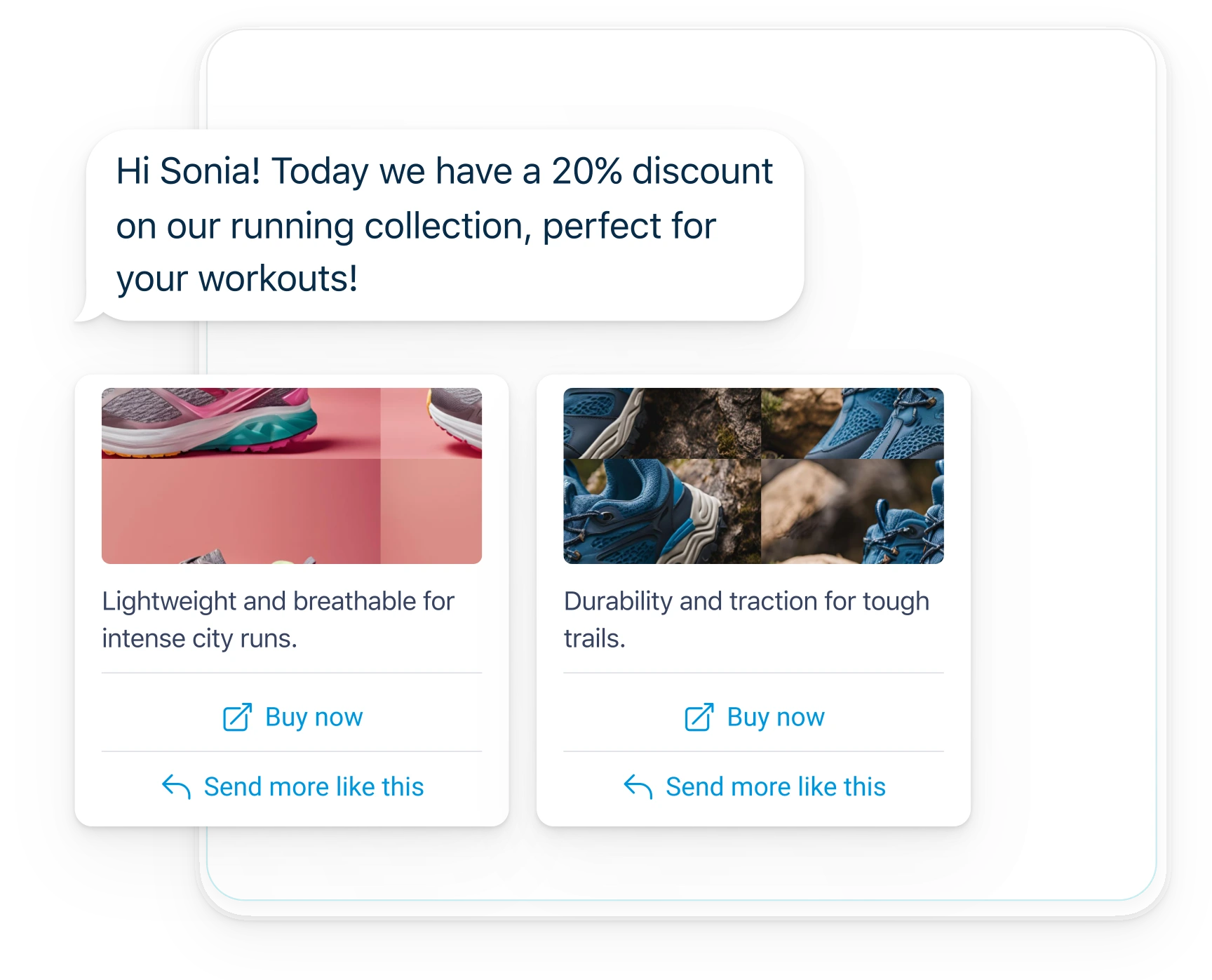
Our take on Meta’s latest announcement confirms a direction we were already seeing: the future of chat needs to be transactional. With the changes to WhatsApp Business Platform pricing, which will start rolling out progressively in October 2026, every message sent by a business will have a clearer impact on operating costs.
That is why the technical design of an agent is no longer just an experience decision. It also becomes a direct variable in profitability.
The facts
Starting October 1, 2026, Meta will begin charging for every message your business sends to a customer on WhatsApp Business. A “service message” is any response you send to a user.
On September 1, Meta will confirm the final rate. For now, the reference price is the same one currently used for utility messages, such as alerts, notifications and confirmations, with differences by country.
If you use Meta Business Agent, MBA, Meta’s new AI model, billing is calculated based on tokens consumed, not messages sent.
Our technical take
Every response sent by your agent is now a direct economic variable. Flow design is no longer just UX: it becomes the main profitability lever for the customer.
Decision trees become economically unsustainable. Every branch is a charged turn. An 8-question tree burns $0.05 to $0.15 in Meta costs before closing a transaction.
Generative AI is the only viable way forward. Designed well, it converts with fewer turns. Designed poorly, it hallucinates or rambles, and that is also cost.
Multi-model routing and cache management are no longer advanced features. They become design requirements to protect the customer’s margin.
Under this model, every message that does not move the user closer to a concrete action becomes a bill with no return. Design no longer optimizes only for experience: it optimizes for margin.
Meta is changing the economics of WhatsApp.
We want to show how to avoid overpaying and turn the channel into a profitable business.
This week, we will share data, tools and real cases.
To understand the size of this impact, we looked at the behavior of millions of conversations processed by Jelou. The conclusion is clear: cost is not defined only by Meta’s rate, but by how many messages an agent needs to solve a request and how many tokens it consumes in each turn.
Our data: millions of conversations processed in LATAM
9 average messages per conversation
Around 52,000 tokens per conversation on average, including input, output, context and tool calls.
Tokens per message: range across Jelou implementations
Optimal, with well-designed flows, disciplined caching and compressed prompts: around 2,000 tokens per message.
Average implementations: around 5,800 tokens per message.
Verbose, baseline without optimization inside Jelou: around 10,000 tokens per message.
LLM cost by complexity: Jelou orchestration
Simple, 3 to 5 messages, 2,000 to 5,000 tokens per message: around $0.08 to $0.12 per conversation.
Medium, 5 to 10 messages, 5,000 to 10,000 tokens per message: around $0.20 to $0.30 per conversation.
Complex, 10 or more messages, 10,000 to 25,000 tokens per message: MBA-in-Jelou $0.30 to $1.50. Third-party $0.70 to $3.50.
Jelou workflow cost per conversation: on average, 5 workflows × $0.009 = $0.045. Deterministic workflows execute predictable logic without calling the LLM, which is why token cost goes down.
Even the most verbose implementation inside Jelou, 10,000 tokens per message, uses 2× fewer tokens than an unoptimized baseline. Well-designed implementations reach 2,000 tokens per message: 10 to 12× less. That range shows the ceiling of disciplined design and the margin that can still be recovered.
Meta vs. Jelou: metric-by-metric comparison
Traditional bots and unoptimized setups consume much more than a well-designed agent needs. Our benchmark from real conversations confirms it:
| Metric | Baseline, typical bot or unoptimized MBA | Jelou observed | Difference |
|---|---|---|---|
| Messages per conversation | 15 to 20+, menus and confirmation turns | 5 to 10 average | Around 2 to 3× fewer |
| Tokens per message | 20,000 to 25,000, verbose context with no cache | 2,000 optimal · 5,800 average · 10,000 verbose | 2 to 10× fewer |
| Tokens per conversation | Around 200,000+, no cache management | Around 18,000 optimal · 52,000 average · 90,000 verbose | 2 to 8× fewer |
| LLM rate, $ / 1M tokens | $2.00, MBA flat rate, or $3 to $15, single premium model | Around $1.00 blended, routing + cache | Around 40% less |
| LLM cost: simple flow, 3 to 5 messages, transactional | MBA: around $0.10 · Raw premium: $0.15 to $0.30 | Around $0.05 with Jelou orchestration | 2 to 5× less |
| LLM cost: medium flow, 5 to 10 messages, basic support | MBA: around $0.20 · Raw premium: $0.30 to $0.60 | Around $0.15 with Jelou orchestration | 1.3 to 4× less |
| LLM cost: complex flow, 10+ messages, tool calling | MBA: around $0.40 · Raw premium: $0.80 to $1.50 | Around $0.30 to $0.45 with Jelou orchestration | 1.3 to 5× less |
| Meta cost, post October 1, 2026 | Depends on the country · charged per message sent | Same Meta rate · fewer messages = lower Meta bill | Around 2× fewer messages |
Efficiency compounds: fewer messages × fewer tokens per message × better rate per token equals a total LLM cost reduction of 50 to 70% and around 2× less Meta cost per resolved conversation.
And there is still room to improve: the most disciplined implementations inside Jelou use 2,000 tokens per message, compared with the 5,800 average, which is 50% less than an unoptimized baseline.
Total cost per conversation: investing in Jelou saves money even when using MBA
Using MBA through Jelou costs less than using MBA directly with Meta.
Jelou orchestrates prompts, caches context and compresses turns, reducing the tokens Meta charges you for. With 9 messages, 5 average deterministic workflows and a medium flow:
| Option | Meta message cost | AI cost, LLM | Jelou workflow cost | Total / conversation |
| Direct MBA without Jelou, Meta verbose baseline reference | $0.00, included in tokens | $0.40 to $0.80, 200k to 400k tokens without optimization | N/A | $0.40 to $0.80 |
| MBA inside Jelou, Jelou reduces tokens | $0.00, included in tokens | $0.20 | $0.045 | $0.245 · 40 to 70% less than direct MBA |
| Third-party inside Jelou · Colombia | $0.007 | $0.28 | $0.045 | $0.332 |
| Third-party inside Jelou · Brazil | $0.061 | $0.28 | $0.045 | $0.386 |
| Third-party inside Jelou · Mexico | $0.077 | $0.28 | $0.045 | $0.402 |
| Third-party inside Jelou · Peru, MBA-in-Jelou wins | $0.180 | $0.28 | $0.045 | $0.505 |
| Third-party inside Jelou · Rest of LATAM | $0.102 | $0.28 | $0.045 | $0.427 |
Calculation model
AI cost: MBA-in-Jelou uses Meta’s flat rate, $2 per 1M tokens, over Jelou-orchestrated tokens.
Third-party uses Jelou’s real blended routing rate, validated across 886M tokens: gpt-4.1 workhorse 88% at $1.02 per 1M tokens + Claude-sonnet-4-6 reasoning at $3.12 per 1M tokens + mini/flash triage at $0.11 to $0.37 per 1M tokens.
For medium flows, the blend moves into an effective premium range and reaches $0.20 to $0.30 per conversation in customer-facing pricing.
Investing in Jelou saves money even when using MBA: $0.40 to $0.80 direct, based on the verbose unoptimized baseline reference, goes down to $0.245 inside Jelou, 40 to 70% less.
MBA-in-Jelou, at $0.245, is the cheapest option across LATAM for medium flows: Meta’s flat token rate absorbs complexity, while third-party scales with the use of premium models. Colombia is the exception: third-party, at $0.332, remains competitive because the Meta rate is low.
With Jelou, you route message by message between MBA and third-party models depending on country, turn complexity or use case.
What to build with Jelou
Reduce cost per message with disciplined orchestration. Aggressive caching for reusable context, prompt compression and multi-model routing based on cost, quality and complexity. Every avoided message, or every cheaper model used in the right turn, translates into a lower bill for the customer.
Connect Meta Business Agent, MBA, where it adds value. MBA has a flat token rate of $2 per 1M tokens, which makes sense for Meta-native or regulated flows. Outside of that, third-party with multi-model routing wins. Jelou lets you mix both by use case.
Design UX that closes transactions with fewer messages. Buttons, lists, catalog, native Flows, calendars and webviews: a checkout that takes 12 messages in free text can take 3 in native Flows. Every avoided message reduces both the Meta bill and AI cost.
Combine voice with advanced visual interaction. AI calls, STT + TTS, while the customer interacts visually on WhatsApp through lists, catalog, forms or webview. AI explains by voice, the customer decides on screen. A single turn can replace 5 to 8 text turns.
Our transactional layer
In the new WhatsApp economy, conversation is no longer enough. Every message should move the user closer to completing an action. Jelou includes a native transactional layer that lets you collect payments, sign and validate identity inside the chat:
Native payments with PCI certification. Collect payments inside WhatsApp securely and in a compliant way.
Contract signing. Close legal agreements inside the chat, with legal validity.
Identity verification, KYC. Integrated with regulatory authorities by country, including DIAN, SAT, AFIP, SUNAT and Receita Federal.
Everything in a single thread. One message can complete a sale, a contract and a verification, without switching apps.
If your customers already have agents on AWS, Azure, IBM, Oracle or Salesforce
Many companies are trying to build their agents on services such as AWS Bedrock, Azure OpenAI, IBM Watsonx, Oracle Digital Assistant or Salesforce Einstein. With the new WhatsApp prices, complementing those services with Jelou becomes more necessary than ever.
Jelou Brain connects with those systems and adds the efficiency that WhatsApp’s new rules demand.
The customer’s team stays focused on its product. Jelou brings orchestration, cost control and LATAM integrations that are already built.
Migrate and build fast, without replacing the customer’s technology. Jelou sits on top of their current systems and integrates Meta AI in record time.
Monitoring and limits. See how many messages and tokens each conversation consumes, define usage limits and compare potential savings based on the AI model you choose. Observability: tokens per message, messages per conversation and projected savings across different models.
Conversation insights to build better. Direct recommendations from Brain AI, our AI that builds agents in WhatsApp, to improve flows instantly.
Concrete design best practices
The deeper learning is simple: in this new model, designing well does not mean making the agent sound smarter. It means making it more precise, shorter and more capable of executing without wasting turns.
Prompt engineering + Aggressive cache. Every response should either close the turn or open the next one with a concrete action. No unnecessary cliffhangers. And everything that can be cached should go to cache: system prompts, RAG contexts, repeated responses, FAQs and quotes should not go to the LLM on every turn.
Efficient design + Multi-model routing. Design every goal for 6 turns or fewer. If a flow requires more, check whether a native Flow, a webview or an AI call can compress it. And route every turn to the optimal model based on cost, quality and complexity: greetings and triage go to mini/flash, complex reasoning goes to premium, regulated Meta-native flows go to MBA. Orchestration applies those rules automatically.
Native WhatsApp components over free text. Buttons, lists, catalog, Flows and webview: every visual selection replaces 2 to 4 text messages and gives more UX options for complex selections.
The competitive advantage of the next 12 months will be built by the teams that design well under the new model.
Jelou is built for what comes next: fewer messages, more transactions, more margin for your customer.
In addition to this article, we will keep publishing design patterns, prompt libraries and cost benchmarks by use case over the next 90 days.